Blue Baby Syndrome, Cancer, and Iowa's Water: The Health Risks of Nitrate Exposure
Blue Baby Syndrome, Cancer, and Iowa's Water: The Health Risks of Nitrate Exposure
In 1945, Dr. Hunter Comly, a pediatrician at the State University of Iowa, published a paper in the Journal of the American Medical Association describing a condition he'd seen in two infants from rural Iowa families. Both babies had turned a disturbing blue-gray color. Both had been fed formula mixed with water from farmstead wells contaminated with high levels of nitrate. The condition became known as blue baby syndrome — or, in medical terms, methemoglobinemia.
Comly's discovery led directly to the federal drinking water standard that still governs Iowa's tap water today: 10 milligrams per liter (mg/L).
The problem is that standard was set to prevent one condition in one vulnerable population. It has never been updated to reflect decades of research linking long-term nitrate exposure to cancer, thyroid disease, and adverse pregnancy outcomes — at levels close to half the current legal limit.
What Is Blue Baby Syndrome?
Methemoglobinemia occurs when nitrate is converted to nitrite in the body (a process that happens more readily in infants because of their less acidic stomach environment). Nitrite then oxidizes the iron in hemoglobin, turning it into methemoglobin — a form that cannot carry oxygen. Affected infants develop a characteristic bluish skin color, become lethargic, and in severe cases can lose consciousness or die.
Infants under six months are most vulnerable because they have lower levels of the enzyme needed to convert methemoglobin back to normal hemoglobin, and because fetal hemoglobin is more susceptible to oxidation. The risk is highest when nitrate-contaminated water is used to prepare infant formula. Iowa's Department of Health and Human Services still considers methemoglobinemia a reportable condition and recommends that families with infants take special precautions.
Source: Iowa HHS Methemoglobinemia Fact Sheet (hhs.iowa.gov); PMC/PubMed: "Blue Babies and Nitrate-Contaminated Well Water"
The Cancer Connection
While blue baby syndrome remains a serious concern, the more widespread health threat from nitrate exposure is chronic and it affects people of all ages. When nitrate is ingested through drinking water, bacteria in the digestive system convert it to nitrite, which then reacts with proteins in the stomach to form compounds called N-nitroso compounds (NOCs). The International Agency for Research on Cancer (IARC) classifies this pathway as a probable cause of cancer in humans.
The research connecting nitrate in drinking water to cancer has been building for years, and much of it has been conducted right here in Iowa:
Colorectal Cancer
A landmark study of 2.7 million people in Denmark found statistically significant increased risk of colorectal cancer at nitrate levels above just 3.87 mg/L — or about a third of the current legal limit. Colorectal cancer is one of the most common cancers diagnosed in Iowa. (PubMed: Nitrate in drinking water and colorectal cancer risk)
Bladder Cancer
A 2016 study published in Environmental Health Perspectives focused specifically on Iowa women. Researchers found significantly increased bladder cancer risk among those with four or more years of exposure to water above 5 mg/L — half the legal limit. (PMC: Nitrate, Drinking Water, Diet, and Bladder Cancer)
Thyroid Cancer
Another Iowa-based study found that postmenopausal women who drank public water with nitrate levels above 5 mg/L for five or more years had 2.6 times the risk of thyroid cancer compared to women with lower exposure levels. (PMC: Nitrate Intake and the Risk of Thyroid Cancer)
Iowa's Cancer Crisis: The Numbers
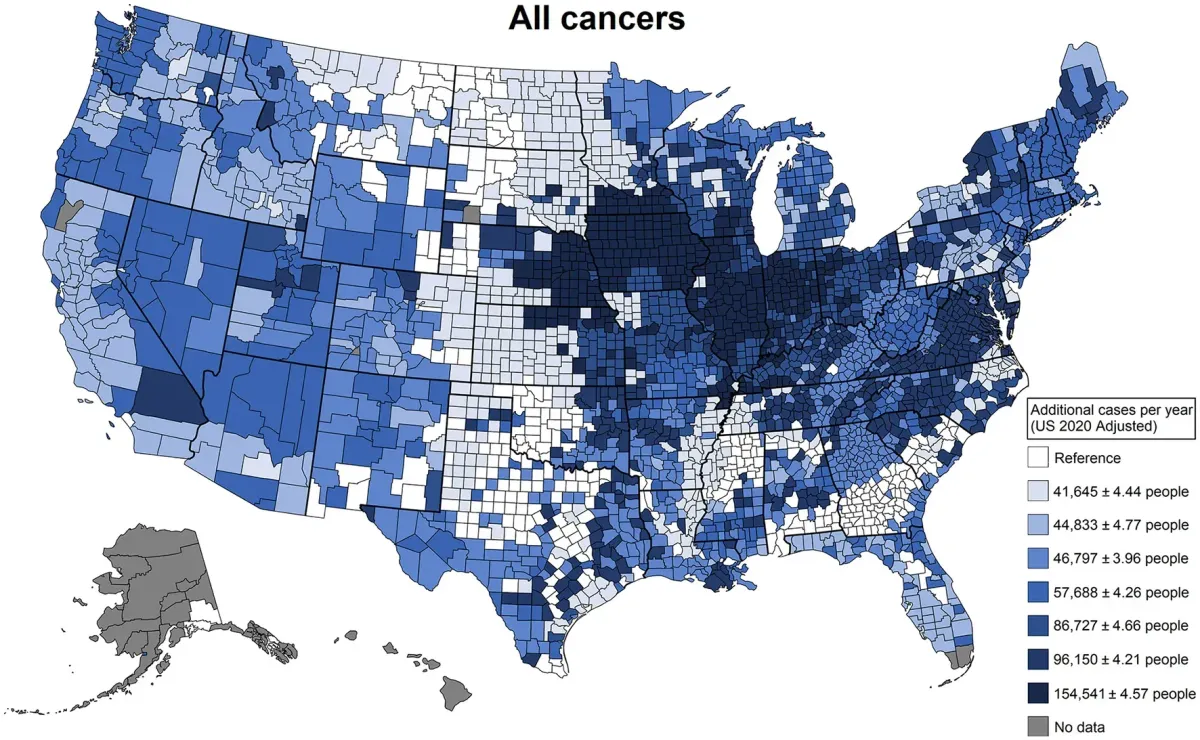
Iowa has the second-highest cancer rate in the United States, behind only Kentucky. According to the Iowa Cancer Registry's annual report, Iowa is one of only two states where cancer rates are still rising (the other is Connecticut). In February 2026, University of Iowa researchers presented findings to Governor Kim Reynolds showing that 87 of Iowa's 99 counties have cancer rates significantly higher than the national average.
An estimated 21,200 new invasive cancers were projected to be diagnosed in Iowa in 2025 alone, with around 6,300 deaths. While cancer has many causes — and official research is still examining the relative contributions of tobacco, radon, alcohol, and environmental exposures — the Iowa Environmental Council has called the connection between environmental pollution and Iowa's cancer rates something that "can't be ignored."
Governor Reynolds acknowledged the severity in her 2025 Condition of the State address, noting that Iowa had ranked second for new cancer cases two consecutive years. She called it "the 'what' of the problem" and funded a $1 million research project at the University of Iowa to investigate why. That investigation is examining environmental factors alongside behavioral ones — and early findings suggest no single cause explains Iowa's outlier status.
Sources: KCRG, February 6, 2026; Iowa Capital Dispatch, February 5, 2026; Iowa Public Radio, February 5, 2026; Sentient Media, March 2025
How Carbon Filters and Reverse Osmosis Differ
Carbon-based filters like Brita and PUR are designed to improve taste and reduce chlorine. Reverse osmosis is a different category of filtration that works at the molecular level on dissolved contaminants.
An RO system pushes water through a semi-permeable membrane at the molecular level, and it operates at the point of use, under your kitchen sink.
For Iowa families — particularly those with young children, pregnant or nursing mothers, or anyone concerned about long-term cancer risk — a household reverse osmosis system is the single most effective step you can take to protect your family's drinking water.
→ Protect Your Family's Water Today
Safe Water Iowa offers reverse osmosis systems designed for Iowa families. DIY installation in under 30 minutes, no plumber needed. 5% of every sale supports Iowa water quality initiatives. Learn more at safewateriowa.com
Sources & Further Reading
KCRG: 87 of 99 Iowa Counties Report Higher Cancer Rates, Feb. 2026
Iowa Capital Dispatch: Gov. Reynolds on Cancer Rates, Feb. 2026
Iowa Public Radio: Cancer Researchers Update, Feb. 2026
Iowa Environmental Council: Cancer and Environmental Risk Factors
Sentient Media: What Is Driving Iowa's Outlier Cancer Rate?